derek sivers
ted fellows friday - meet Robert Gupta

Fellows Friday is a weekly series on the TED Blog that profiles one TED Fellow each week. We have asked the Fellows to answer our question below to share their knowledge and advice with other social entrepreneurs, innovators, and changemakers who are coming up with big ideas that can change the world. Read past Fellows' answers here.
LA Philharmonic violinist Robert Gupta performs for the homeless and mentally ill. In this interview, he explains how music and the creative process heals.
Question: There are many aspiring social entrepreneurs out there who are trying to take their passion and ideas to the next level. What is one piece of advice you would give to them based on your own experiences and successes?
Answer: Focus on helping others before helping yourself. That’s what’s rewarding in the long run.There are many aspiring social entrepreneurs out there who are trying to take their passion and ideas to the next level. What is one piece of advice you would give to them based on your own experiences and successes?
Something that I learned from Derek Sivers, who has spoken at TED very often: “Just do it.”
Another thing I’ve learned from amazing social entrepreneurs at TED is that you don’t have to ask for money first. You don’t have to build up this base of funding and then go and start. It doesn’t work that way. If you have an idea, whether it’s an idea the world thinks is nuts, or it’s one the world embraces, go and do it. Ask for money when you establish that base of what you’re doing.
Ideas evolve. Tim Harford’s TEDtalk talks about “The God Complex,” where people have an idea and think it’s the one and only way things should be done. But it doesn’t work that way. You have to find a way, do it, be wrong, then find a way that it evolves and works.
Read the rest of Gupta's interview here.
- Add new comment
- share it


We Can't All be the Shirtless Dancing Guy
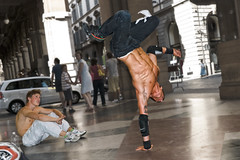
A few weeks ago, I heard Sean Stannard-Stockton speak on a panel at Council on Foundations. He shared a short video by musician and CD Baby founder Derek Sivers, which discusses the leadership lessons than can be drawn from a lone shirtless dancing guy at a music festival.
I recommend watching the video (it's below and it's less than three minutes), but the two basic lessons Sivers shares are:
- Good leaders will nurture their first followers (or first employees or first volunteers) and treat them as equals, so the movement, business or nonprofit is not resting on the one founder or ED's personality. It's truly about the movement.
- The first follower is really the hero. Sure, maybe dancing around shirtless was a good idea - heck, a great idea. But without the first follower who gave his idea momentum and legitimacy, the leader probably would have looked like an loser after a few minutes and given up.
Sean said that his biggest critique of foundations is that they all want to be the shirtless dancing guy when what we actually need is more people who are willing to be the first follower. In other words, more foundations should be looking for organizations who are already doing great work and fund them. Similarly, one of my biggest critiques of my own generation is that we all want to be the shirtless dancing guy too. We all want to be the one with the new idea, the leader of the revolution, the one who makes decisions and, later, motivational speeches. But if we all insist on leading our own initiatives, there are going to be a lot of one-man movements out there.
It's not just that we CAN'T all be the shirtless dancing guy. It's also that we shouldn't. As Sivers says, "The best way to make a movement, if you really care, is to courageously follow and show others how to follow." In the last few years a lot of great Millennial leaders have emerged in both the for-profit and nonprofit sectors, but all of those leaders have had a first follower who saw a shirtless dancing guy and took on some level of risk to join and legitimize his efforts.
So to both the leaders and to those who encourage them, remember that the first follower is just as important to the success of a movement. Don't try to guard your idea and protect it from outside influence and people who might get a piece of your glory pie. Instead, welcome your first followers; let them dance with you. Millennials are particularly good at collaborating and being team players, but I think at times we still need to be reminded that while we are each special and capable of a lot, we need other people.
And being a first follower might be a more humble position, but it's not so bad. Both dancing guys benefited from making the movement work, and the crowd was better for it. Many of my peers want to start nonprofits or businesses, but they aren't sure what that nonprofit or business might be. Usually they are driven by the desires to change the world, make their mark, and do something different - desires that seem to be at the core of why many Millennials roll out of bed in the morning. But if you don't know what need you want to meet and how you'll meet it with your new nonprofit or business, you'll have a greater chance of being part of (and even influencing) a successful and meaningful movement if you just look for the best shirtless dancing guy you can find and be the first to join him.
- Add new comment
- share it