lady gaga
Who Would You Pick as Your Next Spokesperson… Lady Gaga or Your Next Door Neighbor?

It depends on what you’re trying to achieve by having a spokesperson represent your issue.
Many nonprofit organizations have enlisted celebrities to help them not only to raise awareness about a specific issue, but also to support their organization’s fundraising efforts. I bet you can name a few without even having to think twice—there’s Marlo Thomas for St. Jude’s Children Hospital, Heidi Klum for The Heart Truth campaign, and Ryan Gosling who worked earlier this year with the ENOUGH Project.
For some, integrating a celebrity into your promotional model is par for the course—but should it be? While these A-list celebrities certainly draw attention to an issue, just how effective are they when it comes to enlisting the support of donors online?
Today, Geoff Livingston and Henry T. Dunbar of Zoetica released a white paper focusing on the effectiveness of celebrity spokespeople in social fundraisers. The report looked at the effectiveness of a number of online fundraising campaigns for nonprofits—including both those that did and did not— involve high-profile celebrities.
They concluded that a celebrity “presence” does not always guarantee that a fundraising initiative will be successful. Rather, bringing on board lesser known celebrities and “weblebrities” can often times be more effective in connecting with donors. The key differences for the more successful, but less well known celebrities included the fact that they had: a personal and relevant story related to the cause; a willingness to engage and be active with the community focused on that particular issue; and an authentic tie to the cause.
The authors also found that while integration of a celebrity spokesperson can help galvanize a community around an issue, getting a star’s fans and followers to commit to a particular call-to-action—such as donating—is not always a guarantee.
“Nonprofits have turned to their celebrity partners with fans and followers in the millions to raise money. The numbers can be astounding, both positively and negatively. Save the Children just ran a celebrity campaign on social media with the likes of Lady Gaga and Justin Bieber that raised $100,000 in the first day. However, deeper analysis showed the fundraiser achieved $0.0001 per celebrity follower.”
In addition, the 2011 Millennial Donor survey (conducted by Achieve and Johnson, Grossnickle and Associates) found that for Millennials specifically, 85% responded that they are “motivated to give by a compelling mission or cause, and 56% by a personal connection or trust in the leadership of the organization.” Not surprisingly when compared to the findings from this white paper, “only 2% of Millennials were motivated to give by celebrity endorsements.”
Katya Andresen, Chief Strategy Officer of Network for Good offered Livingston and Dunbar three factors to consider when assessing whether or not a celebrity presence could help promote social fundraising efforts:
- Does the spokesperson have a personal story related to the issue?
- Does the spokesperson have a tight knit community that interacts with them?
- Can the spokesperson be considered an authentic messenger who can deliver issue related messages?
Similarly, the white paper offers suggestions for what a nonprofit manager should consider before integrating a celebrity component into their social fundraising campaign.
- Does the celebrity have a personal connections and authentic passion for the cause?
- Does the celebrity spokesperson demonstrate a willingness to ask their personal friends to become involved, and not just their public?
- Welcome the non-traditional celebrity and consider those who are avid users of social media or who have large/strong social networks
Livingston and Dunbar’s ultimate conclusion is that “the best results do not come from the most well-known celebrities and bloggers, but the most engaged ones.” Taking a page from more traditional fundraising techniques that focus on the creation of relationships, the authors conclude that in order for socially driven fundraising efforts be successful, they too must focus on the building of relationships.
Whether or not you get Lady Gaga to do a public service announcement or Justin Beiber to make an appearance at your next fundraiser—real success for any organization’s fundraising and mobilization efforts will come from connections with the creation and cultivation of relationships.
What techniques for online and socially driven fundraising have you used or seen? Have you ever engaged a celebrity spokesperson to help your nonprofit? If so, what lessons learned can you share?
- Add new comment
- share it


The Millennnial Superstar: Lady Gaga

Whether you love her or hate her, surely everyone has something to say about Lady Gaga. From her outrageous fashion to her theatrical performances, Lady Gaga has taken the entertainment industry by storm and has become an international superstar and household name only within a few short years. While her career is often compared to pop stars that have come before her, Lady Gaga is different in that she has come of age in the Web 2.0 era and consistently uses new technology to further her career. She is a Millennial and her Millennial attributes are exemplified throughout her career path.
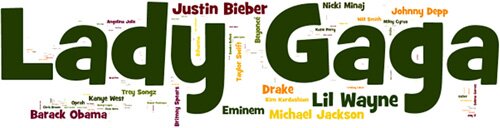
In a recent Fast Company article, MTV’s Nick Shore cited Lady Gaga as the face of the Millennial Generation. Such a grandiose title is supported by an MTV survey that asked Millennials, “Who do you think is the most interesting person in pop culture today?” The response was overwhelmingly dominated by Lady Gaga, as displayed by the info graphic below.
Having been discovered on MySpace, Lady Gaga’s career has developed on pace with advances in technology and social media:
- She was the first artist to reach 1 billion views on YouTube
- She has over 30 million “likes” on her Facebook page
- Her Twitter account boasts more than 9 million followers
- She is the most downloaded artist of all time
Social media is more than just a popularity contest for Lady Gaga – she uses innovative platforms to connect with her fans and build a community of her “little monsters.” Recently, Gaga stopped by the headquarters of Google for an interview to promote Google Moderator, an app that allows fans to submit their questions and users are able to vote on the questions they would like to be asked. Gaga admits to Googling herself, and enjoys browsing YouTube to find videos from her fans.
Like many of her Millennial peers, Gaga is passionate about social good. Lady Gaga is an outspoken advocate for LGBT rights and participates in many efforts to give back. Gaga was eager to do her part to help the victims of Japan’s recent earthquake and tsunami. Leading the way in celebrity efforts, Lady Gaga donated $1.5 million between her participation in Zynga’s initiative with Save the Children and the “Songs for Japan” Charity Album for the American Red Cross.
Whether you see her out promoting Polaroid’s newest product as the brand’s creative director, or you download Vogue’s Lady Gaga exclusive iPad app, remember this sensational star has only recently turned 25 and she is not slowing down any time soon. “She is doing in 10 minutes what it took Madonna ten years to achieve,” says Shore. Like Lady Gaga, many Millennials are only in their early stages of adulthood. The impact they have on technology, social good and society is still developing and there are endless possibilities to grow.
- Add new comment
- share it