social entrepreneurship
A Lost Generation of Entrepreneurs? I think I found them.

Last week BusinessWeek posted an article by Jeff Bussgang, a seasoned investor and entrepreneur, who shared his concern that we are suffering from a lost generation of entrepreneurs. It seems he tried to make a list of significant entrepreneurs under 35 and wasn't able to get very far. Jeff argues that since the 2000s were lean years that did not produce many substantial start-ups, that generation of 20-somethings was not able to develop company-building skills. He says we have not had the opportunity to see success at a young age or learn the important lessons of start-up leadership, so our generation has also missed out on the early start-up experience that would have made great mentors and serial starters later in life. Further, we are lacking good entrepreneurial role models, and he worries the next generation of entrepreneurs too could be lost without footsteps to follow.
With all due respect, I think maybe Jeff worries too much. If he's looking for examples of young people with start-up leadership experience, skills and success, he may just be looking in the wrong place. This generation is less interested in making as much money as possible and more interested in starting organizations that are mission-focused, so we are looking at nonprofits and companies with double or triple bottom lines. While the 2000s may not have been a good time to start a business, that hasn't kept twenty-something entrepreneurs of every stripe from starting nonprofits and social ventures.
As much as I might have tried to discourage them, the upshot of all the Millennial nonprofit start-ups is that people of our generation (successful and not) are learning a lot in the process. I don’t think Jeff should be worried about a lost generation of entrepreneurs; rather, I think he should be glad to see that whatever the economic climate has been, this generation of entrepreneurs is using innovation to address social challenges, even when that means sacrificing opportunities for personal gain – the same types of opportunities that might have drawn them into the circles that would get Jeff’s attention.
In an effort to ease his worries, we at Social Citizens would like to offer few people he can add to his list of under 35 success stories with leadership experience and start-up skills that will have no problem serving as role models for their peers and the next generation of entrepreneurs, who may also focus a little less on profits and a little more on changing the world.
Blake Mycoskie, 33, founded TOMS Shoes with the idea that promising to give away one pair of shoes for every pair purchased. Prior to starting TOMS, Blake has founded four other businesses since college.
Emily Pilloton, 28, who wrote “Design Revolution: 100 Products that Empower People,” and founded Project H Design, a nonprofit team of designers, architects and builders that mobilize product design ingenuity to benefit humanity, habitats, health and happiness. See her on the Colbert Report earlier this year.
Scott Harrison, 34, who left his job as a successful nightclub promoter to start charity:water, an incredibly successful nonprofit providing clean water for hundreds of thousands of people.
Jonny Dorsey, 24, who while in undergrad at Stanford decided to take a leave of absence to start FACE AIDS and oversaw the expansion of the organization to 150 schools across the country. He's now cofounder of Global Health Corps, which strives to promote global health equity.
Ory Okolloh, 34, is a blogger, co-founder of Ushahidi, an innovative technology platform originally developed to map violence after the 2008 Kenyan election, and co-founder of Mzalendo, which tracks the performance of Kenyan policiticans.
Esra'a Al Shafei, 23, who promotes human rights for ethic and religious minorities through multiple online campaigns and is the founder and director of MideastYouth.com, an interfaith network developed to provide young people with freedom of expression.
Sam Adelsberg, 22, who is the co-founder of LendforPeace.org, which allows people to support the resolution of the Israeli-Palestinian conflict through online microloans to vetted entrepreneurs in the West Bank.
Courtney Macavinta, 34, started Respect RX, a social venture that promotes self-respect, relationship respect and respect for all for teens and young adults, and has been featured consistently as an expert on issues facing teens and women.
Jacob Colker, 26, who after managing numerous political and advocacy campaigns founded The Extraordinaries, a social enterprise which gives people the opportunity to volunteer their spare moments for causes they care about using their mobile phones.
I've more than doubled Jeff's "depressingly short list" here, but do your part to help him feel better...add to the list!
- 12 comments
- share it


Putting Stock in Social Enterprise

After seeing young social entrepreneur William Kamkwamba speak recently, I wrote a post wondering how we can find and encourage young people in remote areas who have the potential to change the world. While I'm not sure this question has been fully answered, there are some exciting campaigns, programs and organizations working to capture the entrepreneurial spirit for good. Today is Social Enterprise Day, and this week (November 16-22) in 85 countries including Rwanda, Lebanon, and Bangladesh, efforts as part of Global Entrepreneurship Week are meant to inspire young people to create innovative solutions to social problems. Last year, the first Global Entrepreneurship Week included almost 25,000 events in 77 countries and included more than 3 million attendees.
GEW is an opportunity for idea exchange, mentorship, collaboration and competitions meant to spur innovation among students, like the Global Innovation Tournament, which gives students a week to come up with a solution to a problem (this year, to make saving money fun) and post their results in a YouTube video. Other events this week include business pitch competitions, workshops on how to succeed in a struggling economy or take ideas to scale, speed networking events, and clean technology contests. Initiatives like GEW are encouraging because they provide additional access to young aspiring entrepreneurs and show that the entrepreneurship boom of my generation will be a social entrepreneurship boom. For more reasons why GEW matters, check out Nathaniel Whittemore's post on Change.org. Social Edge, from the Skoll Foundation, which has been promoting social entrepreneurship for years, also has a list of current opportunities for young people around the world.
For Millennials interested in getting a social enterprise-focused graduate degree, the options are growing as well. A few years ago I would never have thought of getting an MBA. I remember talking to one of my mentors about various graduate school programs, and he practically begged me not to get a Masters in Social Work. He said that while a degree in Social Work was admirable and helpful, it wasn't the only option if I wanted to make a difference. Business school, he said, was not just for investment bankers; it could help me run an efficient nonprofit or manage a government agency. Business skills can, and should, be used to help people. Not help them realize that Coke is better than Pepsi or help them decide they need another pair of kicks, but actually help them. Now after working with small nonprofit and entrepreneurial projects in Ethiopia and promoting sustainable economic development in the West Bank, I am fully convinced he was right. As Colleen Dilenschneider wrote recently, especially for our generation, social change is sector agnostic. The kind of sustainable change we want to see will be achieved through a mashup of the public, private and independent sectors, and I want to be prepared to craft that mix. Being profitable and doing good are not two opposing options; rather, they can be achieved at the same time, by the same initiatives.
And as I've been looking into it, I'm encouraged to see that business schools seem to believe the same because there are lots of great programs with a social edge. A few of the programs, many of which have emerged or restructured in the last decade, are below.
- The Center for Advancement of Social Entrepreneurship (CASE) at Duke’s Fuqua School promotes the entrepreneurial pursuit of social impact by teaching students to apply business skills to global problems. Founded in 2002, CASE offers social enterprise-focused coursework, career planning, internships and financial assistance.
- Yale School of Management’s entire MBA program encourages students to think creatively and take risks to improve the world.
- At the University of Michigan's Ross School, a partnership with UM’s School of Social Work and School of Public Policy created the Nonprofit and Public Management Center, which provides opportunities for students to serve on nonprofit boards, take special courses and participate in nonprofit consulting internships.
- Stanford Graduate School of Business lists two of its four key areas as Global Awareness and Social Innovation, recognizing both the far-reaching impacts of globalization and the social impact and responsibilities of businesses.
- Columbia Business School has a Social Enterprise program, which helps students align their personal and professional values in careers that result in social benefits to a broader community. The program's focus areas include Public and Nonprofit Management, International Development and Emerging Markets, Social Entrepreneurship, and Corporate Social Responsibility and Sustainability.
- The Haas School of Business at UC-Berkeley focuses on teaching students to lead through innovation by challenging conventional wisdom, being creative and collaborative and discovering how to seize opportunities. Students who plan to play in the public or nonprofit sectors can take advantage of the Center for Nonprofit and Public Leadership.
- In 2005, the Kellogg School of Management at Northwestern launched the Social Enterprise at Kellogg (SEEK) program to meet the needs of students who want to do well and do good.
By no means exhaustive, this list is exciting just as a demonstration that some of the country's most well-respected schools are investing in leadership for social change, but even at schools which are not yet championing social good in their taglines and focus areas, Net Impact's more than 200 chapters provide business students with resources and networks to seek social and environmental sustainability. And most of these schools are also putting their money where their mouths are. They offer various loan forgiveness or repayment assistance programs, which provide funds to help MBA graduates who are earning relatively lower salaries (i.e. $80,000 or less) working at nonprofit organization or local, state or federal agency.
What other opportunities have you seen for budding social entrepreneurs? What kinds of opportunities are still missing?
- Add new comment
- share it
How Can We Help Others "Harness the Wind"?
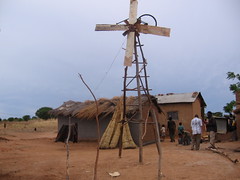
Last week I had the opportunity to hear a talk which left me feeling simultaneously inspired and totally inadequate. William Kamkwamba spoke about his life, experiences and inventions, which are chronicled in his new book The Boy Who Harnessed the Wind. Born in Malawi, William and his family survived off the corn from their small farm in Wimbe. In 2001, a drought drastically reduced the crop yield, and famine grew so severe that his family lived on just one or two mouthfuls of food per day.
Because money was so tight and his family couldn't afford the fees, William had to drop out during his freshman year of high school. Not wanting to fall behind his classmates, William went to a small library nearby and studied textbooks to try to keep up. Without knowing much English, he taught himself physics by studying the diagrams and translating phrases associated with the diagrams. He then built a series windmills almost exclusively using parts he found in a junkyard. Even in the midst of so many challenges and an absolute dearth of resources, William found ways to improve the lives of his family and his community. His house has power in a region where less than 2 percent of people have electricity. He has created a drip irrigation system, a solar power system, and produced the only clean running water in 60 miles.
These days William is a bit of a celebrity. He has spoken at TED and the World Economic Forum, is traveling around the US as part of a book tour, and has appeared on the Daily Show. But as William's co-author Bryan Mealer pointed out, about four years passed between the time that William completed his windmill and the time he was connected to bloggers and reporters in the international community, and even then it seemed very happenstance. I hate to think that we could have easily missed out on William and all that he has to offer, but there are surely hundreds of others like William across Africa and the developing world that "harnessing the wind" unknown and who have the potential to contribute life-changing innovations in their communities and the world. How can do a better job of finding these amazing individuals?
William tells a funny story about the first time someone showed him Google. He said he typed in "windmill" and found millions of articles and designs for windmills, and he wondered "where was this Google all this time?" There are still times when I wonder how I would function without Google. Clearly people like William do it, but the technology I use everyday could make all the difference for them. Now 22 and applying to universities in the US, William will no doubt accomplish many more amazing things in his lifetime, but what would we have missed if someone hadn't found William's windmills and given him opportunities to realize his full potential?
The more we can find these amazing young people who, like William, are harnessing the wind and harness their creativity, perseverance and ingenuity, the better we all will be. The big question is how. We can't simply hop from one rural African village to the next, hoping to stumble across a windmill, without knowing who or what we are looking for. Many organizations, like Ashoka, USAID, TED Fellows, Echoing Green and the Skoll Foundation, try to lift up social innovators in the developing world, but how can we do an even better job of reaching people off the grid?
When William's first windmill was up and running, people were constantly stopping by to charge their mobile phones. In his rural village where most lived without electricity or running water, they had mobile phones, which may not be surprising since projections put mobile phone penetration rate in Africa at about 50 percent this year. Since advancements in mobile technology will probably continue to outpace internet connections in places like Malawi, the answer could lie in mobile. Could we set up a reporting system through which people could easily text innovative ideas, inventions or problem-solving in their communities? Not all young innovators will write books and give TED talks, so is there a way we can use mobile technology to deliver valuable information that will help them gain access to the resources they need? I still have more questions than answers about how people would know where to report these stories of innovation, how they could then be corroborated and how resources could be effectively delivered, but it's worth considering.
William's story is an inspiring one about overcoming adversity, and it's a picture of what individuals can accomplish when they persevere. But it's more than that. It's a reminder that there are untapped resources in young innovative minds around the world, and it's in our interest to find them.
- Add new comment
- share it
Should You Need a License to Make a Difference?

Since my recent post encouraging would-be nonprofit founders to think again before converting their passion and ideas into a 501(c)3, I have been excited to see the great conversation around this issue. Thanks to everyone who has weighed in thoughtfully on entrepreneurship, innovation and replication - those who gave me an amen, gave me a strong rebuttal and, last but not least, gave me a raise. Since this issue seems to have struck such a nerve and it's not as black and white as to found or not to found, I think there's still more conversation to be had about how we can achieve a balance that benefits society.
Geoff Livingston suggests rather than discouraging entrepreneurs, who we're not going to be able to stop anyway, we should help them be successful by providing education and resources. That was my thought with suggesting people pursue incubation or fellowship programs - so that new ideas and models can flourish with help - but the existing programs obviously will not accommodate all the innovators ready to start up. I agree that smart innovation and unique entrepreneurial ways of addressing social problems makes the sector stronger and keeps established organizations on their toes by challenging the status quo. But can we encourage the social innovators we need while redirecting people who have passion and ideas, but who would be more effective as part of an existing initiative?
I will also concede Colleen Dilenschneider's point that even if the new nonprofits fail, there's nothing like hands on experience to teach leaders what it means to run an organization. She cites a 2006 Bridgespan Group study, which says the upcoming leadership deficit in the nonprofit sector will require about 640,000 new senior managers in the next 10 years. No doubt experienced young people will be in high demand. But is there another way these Millennial leaders can capture this learning experience without spending charitable dollars to no other end than knowledge of how to do it better next time?
My colleague Eric Johnson added his thoughts as well, comparing the nonprofit and for-profit sectors. He suggests that as a nonprofit startup, it can be more difficult to know if you're making progress because we don't have great established metrics for success, market valuation, and other mechanisms of the for-profit world. And while many nonprofit leaders are starting to recognize that you have to treat donors like consumers, the structure is complicated because the people who are funding your work are often different, and may have different interests than, the people you are serving.
So what are some possible solutions? As Geoff and I talked more about it, we tossed around one idea. If nonprofits are charged with looking after the social health of our communities, like doctors are charged with looking after our physical health, why shouldn't nonprofit leaders have to be certified to operate? If we require something more of doctors than just a desire to make us well, should we require something more of nonprofit executives than just a desire to make a difference? People have to get licenses to do our taxes, to drive our cabs, to cut our hair, and apparently to collect our rags (see photo), but we are going to give them our extra income without having any guarantee they know how to use it effectively to make the world a better place?
In an ideal world, we would all do thorough research to see how effective organizations are before we give our hard-earned money to them, but the reality is most of us don't. The average person does not have Guidestar bookmarked and is not motivated to break his piggybanks because he sees a tightly run NGO. We don't check nonprofits' 990s, what executive salaries are or how much goes to overhead. Research has indicated that including that financial information in an appeal actually makes donors less likely to give than if they receive an emotional appeal alone.
I know increased regulation sounds like a big Debbie Downer, but it can protect and benefit both donors and nonprofit founders. Is it better in the long run if someone spends two years in a program learning how to run a successful nonprofit than if they spend two years wasting money and time, jumping in before they're ready? If we have a nonprofit version of Bill Gates, Steve Jobs, or Mark Zuckerberg, who have all achieved amazing success and benefitted society without even a college degree, it may not serve us to delay their brilliant innovations, so exceptions would have to be made, but most people fit the rule and not the exception. Maybe a license requirement is just another roadblock, but it's helped me to trust my dentist, my accountant and my stylist as professionals. I think we should brainstorm and consider ways to help steer and encourage people with entrepreneurial passion and ideas toward the smartest choices and the greatest social good.
- 7 comments
- share it
Can Social Entrepreneurism Survive the Slowdown?
We have witnessed several decades of unprecedented economic prosperity and expansion. The social sector was an important part of this seemingly endless expansion of capital and causes. All of this optimism has ground to a halt in the last few weeks, and not, of course, just for the social sector, but for all sectors during these scary times. And, there were signs that some of the shine was beginning to come off of the social entrepreneurial wagon.
Late in September, Trabian Shorters, an experienced social entrepreneur and funder at Ashoka, wrote this impassioned plea to young people with Kiva and DonorsChoose fantasies:
"Social change is NOT a field. It is a calling - a profession in the original meaning of the word. You may be called by your faith, your conscience, your ancestors, or your circumstances but the optimistic belief and integrity of a zealous changemaker (by whatever label) is vital to human progress. That makes it sacred."
Tea, Strategy, and Social Entrepreneurship
In a perfect blend of business and social entrepreneurship, Jonathan Pezier, a brilliant activist/technologist, is offering his two passions -- green tea and social change -- at a steep discount on his new site Green Tea Lovers.
The objective of this offer is to promote both knowledge and a healthy lifestyle. So exclusive access to this publication is being complimented with a discount on our healthy teas. To receive this free publication visit the tea shop and select from over 75 varieties of healthy teas and tea ware. After making your selection enter coupon code: GS20TIPS in the shopping cart to receive "20 Tips" by E-mail Plus A 10% DISCOUNT on your tea. If you've been looking for an excuse to try green tea - this is it!
Now if only there was dark chocolate involved ...
- Add new comment
- share it