university
Attention Students, Twitter 101 is now in session
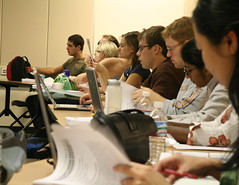
Guest blogger Brannon Cullum is a graduate intern at the Case Foundation, working on a Masters in Communication, Culture and Technology at Georgetown University. Her post is part of a series we have been doing on some intersections of social media and the college experience.
Despite reports earlier this summer indicating that young people were not using Twitter, market research firm comScore released new data last week revealing that younger age groups are “flooding the fastest” as the demographics for Twitter users begins to shift. The shift comes at the same time many young adults are heading back to college. So, beyond following their favorite celebrities and athletes, or finding out what’s for breakfast in the dorm cafeteria, how can Millennials use Twitter on campus?
One first step is to see if your college or university has jumped on the bandwagon and created a Twitter account. There are official institutional feeds, as well as specific accounts for various areas of university life. I’ve come across Twitter feeds for admissions, athletics, arts, campus life, libraries, academic departments, campus newspapers, and other student groups. Check out onlineschool.org’s list of the Top 100 Twitterers in Academia for a broad list.
GlobalQuad.com is a new website that aggregates both official university tweets and personal tweets from student, staff, or faculty and allows you to filter results by college or university. There are nearly sixty colleges and universities currently featured on the site, which is edited by Natan Edelsburg, an NYU undergraduate. This site seems very useful if you want to locate all of the different people or departments tweeting at your school.
Are you tweeting in class? There is a growing movement of professors using Twitter in the classroom as a way to liven up the traditional lecture and help students feel more engaged with course content. Some professors are using Twitter to share information, links, and news related to course content with students; others have designated specific hashtags for a course to organize and aggregate tweets. If you don’t have time for office hours and your professor has a Twitter account, sending him or her a direct message is a quick and easy way to connect.
Monica Rankin, a History professor at the University of Texas at Dallas, experimented with Twitter during the spring 2009 semester, using it as a tool to organize class comments and questions. Students were encouraged to “live tweet” during class and the feed was projected on a large screen in the classroom. In her reflections on the experiment, Rankin notes that by using Twitter she was able to engage some students who otherwise would not have participated in class discussion.
Perhaps many Millennials did not rush to join Twitter earlier because they saw tweeting as the same thing as posting a Facebook status update. While Facebook updates are limited to a person’s friends, tweets can be read by anyone. For college students who are interested in networking or publicizing a student group or event, Twitter can be quite useful.
Looking for a job or internship? Twitter is a great place to start. Georgetown University’s Career Services is offering a webinar to its students to learn how to “tweet yourself to a job.” It is one of many university career centers using Twitter to share information with students. If you have a particular career in mind, start building a network of people on Twitter that are in your specific field. This will make it a lot easier to connect with professionals once you graduate and need advice or are looking for employment.
If you want to start tweeting, Megan Jones has a useful list of the top 25 tips for college students using Twitter. Advertising professor Samuel Bradley has an extremely helpful guide as well. We Follow, a directory of Twitter users, has listings for Millennial Tweeters, too. What Twitter trends are you seeing on campus? Do you think Twitter has a place in the classroom?
- Add new comment
- share it


Student Loans: We All Seek Forgiveness
The Chronicle of Philanthropy recently posted information about the Department of Education’s request for feedback on proposed regulations regarding implementation of the College Cost Reduction and Access Act of 2007.
Come again?
Basically, this new law forgives the remaining debt of student loan recipients who have worked as full-time “public service employees” for a period of 10 consecutive years while making their payments. In other words, you graduate, land a solid gig at a nonprofit, government agency, or other still-to-be-defined “public service” employer, and you won’t have to pay any more monthly debt owed after 10 years working there or remaining in the sector. Read more »
- Add new comment
- share it
How Green Is Your Campus?
I stumbled across a new website from the Hearst Company called The Daily Green. It has great tips for living a green lifestyle. The list of the 12 greenest college campuses caught my eye. Here are the top six on their website: Read more »
- Add new comment
- share it