online fundraising

Fighting Malaria in Age of Twitter: Nets Save Lives, So Do Retweets

Smiling Child Carrying Bednet Bag on Head

Every 30 seconds a child dies of malaria. Nets save lives. So do retweets. RT2Give $10 http://rt2give.com/t/425

The messaging is so powerful, so clear, and so tweetable – and with the World Bank’s bold announcement yesterday that they are stepping in to fill half of the 50 million “bed net gap,” the Case Foundation together with Malaria No More and Twitter thought there was no better time to launch a citizen driven campaign using the powerful force of the 100 Million users on Twitter.

Let’s take a look at the numbers:

  • At present 200 million mosquito bed nets have been delivered across sub-Saharan Africa, affording protection to half of the world's population at risk of malaria.  
  • 100 million more bed nets are in the process of being produced and delivered, leaving a 50 million bed net gap to meet the United Nations Secretary-General's goal of universal coverage by year's end.  
  • Every thirty seconds a child dies from malaria in Africa. However, malaria is a completely preventable and treatable disease.
  • There are approximately 50 million "tweets" sent across the twitterverse each day

On Wednesday, the UN Envoy for Malaria Ray Chambers, appointed a group of 50 Social Media Envoys dedicated to utilizing their social profile to keep online and offline media audiences focused on the movement, milestones and resources required to achieve the Secretary-General's goal of providing all endemic African countries with malaria control interventions by the end of 2010. From Kim Kardashian and Shaq to Bill Gates and Steve Case, these social media influencers are stepping up to use their collective 50 million person following for social change.

We saw the recent power of "texting to give" to the tune of $35 million raised through a variety of campaigns related to the tragic earthquake in Haiti.  These campaigns were a game changer for how we use mobile to respond to crises.   Now together through the powerful combination of tweeting to give and texting to give - we can educate, raise awareness, and help eradicate Malaria for the world’s most vulnerable.

So what can Social Citizens do to show their support and become social media envoys among their own networks? Please visit hope140.org/endmalaria and:

  •  Tweet this message to make a $10 donation to Malaria No More: Every 30 seconds a child dies of malaria. Nets #endmalaria. So do retweets. RT2Give $10 http://rt2give.com/t/425 ( If you already have an account through Twitpay, you’ll receive a direct message from @Twitpay asking for confirmation. If you don’t have an account, @Twitpay will send you an @reply message with simple instructions on how to enroll).
  • Text ‘NET’ to 85944 to make a $10 donation to Malaria No More. (A $10 donation will be charged to your mobile phone bill. Messaging and data rates may apply)
  • Add hashtag(s) #endmalaria, #malaria, #malariaday and/or #worldmalariaday to your tweets and the hastags will trigger the addition of  clickable mosquito icons to the tweet that will take you to hope140.org/endmalaria

The Case Foundation will be matching every ten dollar donation now through April 27 up to $25,000.  The “End Malaria” effort is an extension of last year’s World Malaria Day Twitter challenge between Ashton Kutcher and CNN for a race to 1 million followers. Kutcher’s pledge of $100,000 to Malaria No More catapulted him to success and helped provide Senegal with 89,724 life-saving mosquito nets.

It's Beth's Bithday, "Be A Generous Geek"
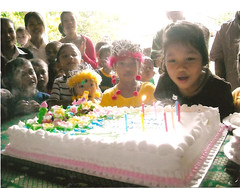
Beth's 52nd Birthday

As social media maven Beth Kanter celebrates her 53rd Birthday today, she does so in true Kanter style, using the tools and techniques that she blogs about each and everyday to teach, inspire and raise money for the Sharing Foundation which will help send 53 more Cambodian children to school. 

Beth is an NPtech pioneer.  She has influenced countless numbers of individuals, nonprofits and changemakers to more effectively use social media for social change.  That’s why I was delighted when Amy Sample Ward and Stacey Monk asked if I’d join in on their birthday blogging surprise party for our friend Beth. There are numerous posts and conversations I could point to that have inspired me personally, and I wanted to share with you just a few of the ways that Beth has influenced this constantly evolving space.   
 
Beth is a teacher: whether it’s through her creative use of finger puppets or through her deep and informative blog posts Beth has a way of sharing information so that you don't only understand it, but you want to jump on the next opportunity to test it out yourself. After all, we know that social media is about trying new things and there is no better experimenter out there than Beth.
 
Beth is an analyzer: she doesn’t just share information, she breaks it down and provides deep analysis and case studies. The Case Foundation benefited directly from this through Beth and Allison Fine's analysis of our first Giving Challenge.
 
Beth is generous: perhaps this speaks for itself, but Beth is a giver. She reminds us the importance of using social media to engage in conversation, it's not a one way street. Beth comments on other people's blogs, she retweets great information, she shares case studies and deep analysis of the issues, she donates to causes she cares about. And, if you too want to know how to be a "Generous Geek" check out the presentation below she gave this past summer at Mashable's Summer of Social Good.

Be A Generous Geek: Mashable Summer of Social Good

Happy Birthday Beth from all your friends at the Case Foundation!


Why Spend Time Chasing Younger Donors with Fewer Dollars?

First Entrepreneurial Five Dollars

Today’s guest blogger, Derrick Feldman, is CEO of Achieve where he provides guidance to organizations to help them develop new fundraising strategies. Today, Derrick continues the conversation we began last week on the importance of engaging younger donors and why fundraising isn’t just about raising money.

Fundraisers often ask, “Why should I spend time working with young donors?” In response, I challenge them to perform a simple test: analyzing the age of their current donor base. If they‘re like many organizations, they’ll find a significant number of donors age 40 and over.  Some of you might be thinking, “That’s where the money is; that’s the most efficient base. If I can meet my goals focusing on that base, why spend time chasing younger donors with fewer dollars?”
 
It is true that a lot (but not all) of the money is in that older demographic. But fundraising isn’t – and never should be – simply about raising money today. It’s about developing relationships that result in long-term stability and effectiveness. Achieving that objective requires diversity. Think of your investment portfolio: It requires investment in long-term vehicles as well as those with a quicker, more short-term return. Similarly, when it comes to cultivating donors, you need to work with those who can make an immediate impact as well as those who have the ability to contribute stable returns over a longer period.
 
So, it’s not about why you should focus on engaging young donors. It’s about how you do it.
 
Before we talk about how to engage these donors, though, I want to offer a quick caveat. You might be tempted – as many organizations are – to pursue this effort to become relevant with the 20- to 30-something audience by setting up a Facebook page or some other social media site. Many organizations assume that, simply by putting themselves in that setting, they’ll attract young donors to their mission. But this approach often fails because, simply put, technology can be a useful tool, but it is not the answer for reaching young donors.
 
To reach young donors, you have to consider what they respond to based on life, work and personal interest. In our experience and research, we’ve found that young donors respond best to organizations offering the following four benefits.

A personal connection to the mission

Typically, young donors are involved in organizations related to causes or issues by which they or someone close to them have been personally affected. If a woman fights cancer, she might enlist in a cancer-related organization. If a man loves to read, he might volunteer to battle illiteracy. If a young family has overcome poverty, they might volunteer at a food bank. Once connected to an organization, these people want to help shape the direction or have the opportunity to directly assist someone served by the organization.

Networking
Young donors and professionals view involvement as an opportunity to network with like-minded individuals. They also see involvement in an organization as a means to meet other professionals and local community leaders – possibly with the objective of eventually serving in larger, more powerful organizations.
 
Social Atmosphere
Young donors are encouraged by opportunities to work with and be involved in organizations with a social atmosphere. They want opportunities to volunteer, attend or participate in programs of organizations where the experiences are lively, upbeat, and positive.
 
Easy to plug in
Young donors are looking for easy ways to get involved. They respond to calls to action and clear methods to make a difference. If, when they look at websites and other information for an organization, they find it cluttered, or they can’t clearly see next steps, they will move on to another, easier-to-reach opportunity.
 
All organizations should embrace these four key elements as they develop a fundraising strategy for young donors. It can be a fairly straightforward process. For example, some organizations develop societies and clubs for young donors – as part of the club, the young donors connect with other young donors in unique social settings, meet with key leaders and volunteer. These kinds of societies provide an entry point for young donors to get involved. Yes, social media can help to support this effort, but don’t assume that social media alone will build this base.

Also don’t assume that, once you’ve made your connections, you can stop there. You must – as you would with any donor – continue to develop the relationship. Cultivate and visit with young donors to show how you admire their passion and how they can affect the work of the organization. Give them opportunities to rub shoulders with more veteran donors and community leaders. Listen to their ideas and make them feel connected to the mission. Offer them private meet-and-greets with board members before board activities, invite them to work with staff to shape a strategic plan, etc.

In short, engage that young donor’s enthusiasm, passion to improve the community and desire to connect his or her personal network with the work you do, and you might be surprised by the result. You likely will develop a relationship that pays long-term returns.
 
Is it worth the effort? Absolutely. After all, these young donors aren’t young forever.

These Days "DM" Means Direct Message, Not Direct Mail

Plastic money

Last week, I had the pleasure of participating in Allison Fine’s monthly Social Good podcast for the Chronicle of Philanthropy.  Together with Tom Watson, we discussed how organizations large and small are raising dollars and awareness through online fundraising contests. There’s certainly no shortage of these contests as we’ve seen in recent months, but as the end of 2009 fast approaches, contests aren’t the only way that organizations are raising money online.  We know that a little creativity in reaching and keeping new donors has never been more important.

As the Nonprofit Times suggested to organizations last week, “it might be time to check to see if your online donation page is working because more than 111 million people plan to use the Web to give to nonprofits this holiday season.”  This according to a new report by Convio, that estimates more than $4 billion in donations will be made online this year, up about $1 billion from last year’s holiday giving season.
 
While the survey found that charity Web sites are the biggest influence on online consumers' decision to give (44 percent), it’s not just your online donation page you should make sure is up to snuff, because today’s donors will be looking for your Twitter handle, your Facebook fan page, or they may simply stumble upon you via Google.  As John Haydon pointed out in a post today, you need to think of Facebook, Twitter and Google as your organization’s new homepage. After all, nearly 25 percent of respondents to the Convio survey said that what family and friends say on social media platforms and in personal e-mails influences their decisions on which charities to support. 
 
I admit to being on a bit of soap box these days as I talk about the need for nonprofits to focus on cultivating the next generation of donors, my peers the Millennials.  While we may not all have the financial means to give in a significant way today, there are two things that should not be overlooked: the collective power of our individual smaller donations, and our high expectations for a seamless experience when donating online or via mobile devices. It’s safe to say that we’ll be reaching for our laptops to donate to causes we care about much more quickly than we could ever find our checkbook and a postage stamp.
 
With this in mind, I turned to the data to see who was giving online and expected to see more of a discrepancy when it came to the breakdown by age (with Gen X and Gen Y leading the way).  Perhaps it’s time to get off of the Millennial soap box, because on average about 60% of people across the board are giving online. Of the survey respondents, 66 percent of Younger Boomers, categorized as ages 44 to 53, said they would donate online this holiday season, followed by 65 percent of Generation X respondents, ages 30 to 43; 64 percent of Generation Y, ages 18 to 29; 60 percent of Seniors, ages 65 and older; and, 59 percent of Older Boomers, ages 54 to 64.
 
It’s clear there is still no silver bullet for fundraising. Charities must promote their causes across all channels and simply putting up a website, or having a presence on a social network site, is not enough.  As Tom Watson was quick to point out in last weeks podcast, “organizations that do the best, fear the least – they let people do their own fundraising.” So, how can your organization use this holiday season to appeal to new donors online? This post started with a focus on how to reach Millennials donors, but these traits can be applied broadly to attract any donor who is among the 60 percent following this generation’s lead in going online for their end-of-year giving.
  • Make an emotional connection, but make sure you do so in an authentic way
  • Place a premium on involving peers and friends – remember, Millennials trust their social networks above anyone else and can see right through gimmicks and marketing ploys
  • Try to go where they are, and do more than just ask for money. It can be as simple as follow us on Twitter, or share this link on facebook.
  • Don’t expect a second chance to make a first impression, if they don’t give the first time, you may lose them forever
  • Treat them (and all donors) with respect, and be quick to thank them for their support – yes, they expect that immediate recognition
  • Don’t forget why you’re asking. If you can’t tell your story in a clear and compelling way, one of the 1.1 Million other nonprofits competing for their attention can
 
 
Syndicate content