TED
Ted fellows friday - meet Kamal Quadir

Fellows Friday is a weekly series on the TED Blog that profiles one TED Fellow each week. We have asked the Fellows to answer our question below to share their knowledge and advice with other social entrepreneurs, innovators, and changemakers who are coming up with big ideas that can change the world. Read past Fellows' answers here.
Creator of CellBazaar, a virtual marketplace that can be accessed via mobile phone, Kamal Quadir is on to his next mobile phone-based venture, bKash. This new company provides access to financial services through the mobile phone. Kamal divides his time between homes in America and Bangladesh, yet this nationally-recognized artist still squeezes in time to paint -- sometimes while on an airplane home!
Question: There are many aspiring social entrepreneurs out there who are trying to take their passion and ideas to the next level. What is one piece of advice you would give to them based on your own experiences and successes?
Answer: Every country, and every community, is very different. What I find is a good way of solving problems in Bangladesh or the US may not be applicable to somewhere else. So a social entrepreneur must figure out, “What is the competitive advantage we have here?”
I spoke of Bangladesh’s tremendous mobile network before. But Bangladesh has other competitive advantages. For example, how is Bangladesh able to feed the equivalent of half the US population, from land area that is the size of the state of Wisconsin? We have farms that can be harvested four times a year. Things grow very quickly. If you have a mango seed and plant it, in a few years you’ll have a mango tree growing mangoes.
In such a populous country, our biggest resource is our people. When I do a project here, a lot of people are always involved. When I did CellBazaar, I involved hundreds of people to educate millions of people on how to use the technology.
This time, with bKash, which is a joint venture of a US company Money in Motion and BRAC Bank, I am literally deploying thousands of people to teach millions of people how to use bKash. Why spend money on expensive newspaper or television ads that may not reach the target market very well? If I teach common people to go door-to-door to teach people how to use this mobile banking, it is not only creating jobs, it’s also giving people first-hand teaching of a new technology which really cannot be taught with those expensive ads.
So finding the advantage and capitalizing on it is the important thing. Think hard and find out, “Is this my competitive advantage?”
Read the rest of Kamal Quadir's interview here.
- Add new comment
- share it


ted fellows friday - meet Genevieve von Petzinger

Fellows Friday is a weekly series on the TED Blog that profiles one TED Fellow each week. We have asked the Fellows to answer our question below to share their knowledge and advice with other social entrepreneurs, innovators, and changemakers who are coming up with big ideas that can change the world. Read past Fellows' answers here.
Genevieve von Petzinger’s database of prehistoric geometric shapes in cave art reveals some startling insights. More than mere doodles, the signs used across geological boundaries suggest there may have been a common iconography before people first moved out of Africa. When did people begin graphic communication, and what was its purpose? Genevieve studies these questions of our common heritage.
Question: There are many aspiring social entrepreneurs out there who are trying to take their passion and ideas to the next level. What is one piece of advice you would give to them based on your own experiences and successes?
Answer: To fund my research, I’ve often had to put it on hold to work –- always in totally unrelated fields, like international banking -- in order to make money to keep funding my degrees. I now have some grants, which is great, but I think that this could be a useful perspective for social entrepreneurs to keep in mind: while it’s really great for social entrepreneurs to work on things like global health and climate change -- things that are important, and may seem more on the ground and in the present -- I think it is equally important to continue to expand our body of knowledge as a species. This is part of what makes us so strong. If people stop paying attention to the more theoretical or esoteric research, I believe this could end up costing us in the long run. I think that research is what helps drive us forward. So I might suggest that social entrepreneurs could expand their vision of what working for the “social good” might include.
Read the rest of Genevieve's Fellow's Friday post here.
- 1 comment
- share it
TED Fellows Friday - Meet Meklit Hadero

Fellows Friday is a weekly series on the TED Blog that profiles one TED Fellow each week. We have asked the Fellows to answer our question below to share their knowledge and advice with other social entrepreneurs, innovators, and changemakers who are coming up with big ideas that can change the world. Read past Fellows' answers here.
Meklit Hadero’s soulful songs have launched her explosive rise in the music world. Her sound draws from jazz, West Coast folk, and her Ethiopian roots. Meklit’s performances and community outreach projects - in North America, Africa, or where the winds take her - continue to enrich her music and be an integral part of its evolution.
Question: There are many aspiring social entrepreneurs out there who are trying to take their passion and ideas to the next level. What is one piece of advice you would give to them based on your own experiences and successes?
Answer: You do what you want to do, by doing what you want to do. Meaning, you get the experience you need, by doing the work. So the important thing is to start doing the work.
The other thing is, when you have a big idea, sometimes if you really knew everything it would take to do it, you would never do it, because it’s always going to take more than you think. So there’s this aspect of really needing to just jump in. That also means you’re probably going to make a lot of mistakes. But you’ll be learning from them, and growing from them as well.
Finally, I’d say to do what you can to help others on their path. It really comes back to you. For me, running the Red Poppy Art House was really all about creating a space for artists from multiple cultures to find each other and flourish from the meeting, as well as to have a place that helps artists to actually live as artists. Through that work, I inadvertently found the musicians who have become my band, the fans that support my music, and the inspiration that comes from interacting with artists of so many disciplines.
Read the rest of Meklit's Fellows Friday post here.
- Add new comment
- share it
TED Fellows Friday - Meet Viraj Puri

Fellows Friday is a weekly series on the TED Blog that profiles one TED Fellow each week. We have asked the Fellows to answer our question below to share their knowledge and advice with other social entrepreneurs, innovators, and changemakers who are coming up with big ideas that can change the world. Read past Fellows' answers here.
New York restaurants and grocers scramble to get their hands on fresh, local produce, so what could be better than veggies grown right in the city? On a rooftop in Brooklyn, Viraj Puri runs Gotham Greens, a hydroponic greenhouse that cultivates delicious, fresh produce - using a fraction of the water and space needed for conventional agriculture.
Question: There are many aspiring social entrepreneurs out there who are trying to take their passion and ideas to the next level. What is one piece of advice you would give to them based on your own experiences and successes?
Answer: Assemble a good team of people, because people have different skill sets. In our case, we wanted to have people with the right technological know-how, people with the right financial know-how, both in terms of raising capital and managing finances and writing a business plan, getting things on paper. Here we’ve tried to assemble a team of people with different skill sets. I think we complement each other and bring different skills to the table.
So if I were to give advice to a social entrepreneur, I would say become a group of social entrepreneurs. Two or three heads are better than one.
Read the rest of Viraj's Fellows Friday interview here.
- Add new comment
- share it
TED Fellows Friday - Meet Jon Gosier

Fellows Friday is a weekly series on the TED Blog that profiles one TED Fellow each week. We have asked the Fellows to answer our question below to share their knowledge and advice with other social entrepreneurs, innovators, and changemakers who are coming up with big ideas that can change the world. Read past Fellows' answers here.
To help journalists and emergency responders, Jon Gosier is developing SwiftRiver, a platform that sorts massive amounts of web and SMS data for accuracy. With his Ugandan innovation hub Appfrica standing on its own two feet, Jon has moved back to the US. Co-Founder of metaLayer, a company that adds visual data to real world scenarios, Jon continues to translate meta-data into digestible pieces applicable to users’ lives.
Question: There are many aspiring social entrepreneurs out there who are trying to take their passion and ideas to the next level. What is one piece of advice you would give to them based on your own experiences and successes?
Answer: If you have a good idea, the most important thing, if you want to be successful, is to execute on that idea, no matter how sparse your resources.
When I started Appfrica, I used my own savings. Although I thought it was a good idea - and people tell me it’s a great idea now - at the time, no one would support it. The only reason it was even moderately successful is because I did it anyway.
I can say that, all across the industry, most success stories come from perseverance and tenacity; not necessarily having all the right resources at the right time.
- Add new comment
- share it
TED Fellows Friday - Meet Sean Gourley

Fellows Friday is a weekly series on the TED Blog that profiles one TED Fellow each week. We have asked the Fellows to answer our question below to share their knowledge and advice with other social entrepreneurs, innovators, and changemakers who are coming up with big ideas that can change the world. Read past Fellows' answers here.
Sean Gourley analyzed real-time data from the Iraq war and discovered a precise mathematical model underlying it. Now he’s expanding on that research at Quid, his startup that maps trends in technology. Having unearthed such powerful information, Sean takes time to help kids understand the importance of math, even while he grapples with the eternal Frankenstein question.
Question: There are many aspiring social entrepreneurs out there who are trying to take their passion and ideas to the next level. What is one piece of advice you would give to them based on your own experiences and successes?
Answer: What’s worked for me is having a sense of, and belief in, who I am and what I’m doing. That’s a foundation I always go back to. My naive impression starting out was that the world will immediately get it and understand it. The reality is, if you’re really trying to do something new, most of the world won’t even care about it. Or, if they do care about it, they won’t really understand it. But over time and with persistence, it comes together.
The other bit of advice is just that if you are putting together a social entrepreneurship team, make sure you have the ability to tell your story and your vision, and the ability to get good people to come work with you on it. It’s so, so much about the team. As you get big enough, you can’t do it by yourself. Getting the right people together and getting them working together on the right problems is going to dictate how successful you are. That is the main learning for me.
Read the rest of Sean's Fellows Friday post here.
- Add new comment
- share it
How Can We Help Others "Harness the Wind"?
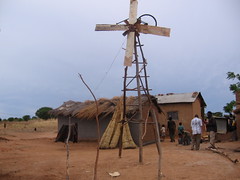
Last week I had the opportunity to hear a talk which left me feeling simultaneously inspired and totally inadequate. William Kamkwamba spoke about his life, experiences and inventions, which are chronicled in his new book The Boy Who Harnessed the Wind. Born in Malawi, William and his family survived off the corn from their small farm in Wimbe. In 2001, a drought drastically reduced the crop yield, and famine grew so severe that his family lived on just one or two mouthfuls of food per day.
Because money was so tight and his family couldn't afford the fees, William had to drop out during his freshman year of high school. Not wanting to fall behind his classmates, William went to a small library nearby and studied textbooks to try to keep up. Without knowing much English, he taught himself physics by studying the diagrams and translating phrases associated with the diagrams. He then built a series windmills almost exclusively using parts he found in a junkyard. Even in the midst of so many challenges and an absolute dearth of resources, William found ways to improve the lives of his family and his community. His house has power in a region where less than 2 percent of people have electricity. He has created a drip irrigation system, a solar power system, and produced the only clean running water in 60 miles.
These days William is a bit of a celebrity. He has spoken at TED and the World Economic Forum, is traveling around the US as part of a book tour, and has appeared on the Daily Show. But as William's co-author Bryan Mealer pointed out, about four years passed between the time that William completed his windmill and the time he was connected to bloggers and reporters in the international community, and even then it seemed very happenstance. I hate to think that we could have easily missed out on William and all that he has to offer, but there are surely hundreds of others like William across Africa and the developing world that "harnessing the wind" unknown and who have the potential to contribute life-changing innovations in their communities and the world. How can do a better job of finding these amazing individuals?
William tells a funny story about the first time someone showed him Google. He said he typed in "windmill" and found millions of articles and designs for windmills, and he wondered "where was this Google all this time?" There are still times when I wonder how I would function without Google. Clearly people like William do it, but the technology I use everyday could make all the difference for them. Now 22 and applying to universities in the US, William will no doubt accomplish many more amazing things in his lifetime, but what would we have missed if someone hadn't found William's windmills and given him opportunities to realize his full potential?
The more we can find these amazing young people who, like William, are harnessing the wind and harness their creativity, perseverance and ingenuity, the better we all will be. The big question is how. We can't simply hop from one rural African village to the next, hoping to stumble across a windmill, without knowing who or what we are looking for. Many organizations, like Ashoka, USAID, TED Fellows, Echoing Green and the Skoll Foundation, try to lift up social innovators in the developing world, but how can we do an even better job of reaching people off the grid?
When William's first windmill was up and running, people were constantly stopping by to charge their mobile phones. In his rural village where most lived without electricity or running water, they had mobile phones, which may not be surprising since projections put mobile phone penetration rate in Africa at about 50 percent this year. Since advancements in mobile technology will probably continue to outpace internet connections in places like Malawi, the answer could lie in mobile. Could we set up a reporting system through which people could easily text innovative ideas, inventions or problem-solving in their communities? Not all young innovators will write books and give TED talks, so is there a way we can use mobile technology to deliver valuable information that will help them gain access to the resources they need? I still have more questions than answers about how people would know where to report these stories of innovation, how they could then be corroborated and how resources could be effectively delivered, but it's worth considering.
William's story is an inspiring one about overcoming adversity, and it's a picture of what individuals can accomplish when they persevere. But it's more than that. It's a reminder that there are untapped resources in young innovative minds around the world, and it's in our interest to find them.
- Add new comment
- share it
The Tribe Has Spoken: Learning's from Seth Godin's TED Talk
Everyday I'm afforded the opportunity to speak with people who are creating movements. Whether it’s bringing clean water to Africa; expanding the volunteer service movement so that all Americans who want to, have an opportunity to serve; helping the 80 million members of the Millennial Generation find meaningful jobs – you name it and it seems there’s a movement afoot.
Earlier this week, Seth Godin’s talk from this year’s TED Conference in Long Beach, CA was released online. What Godin shares is that everyone is capable of starting a movement, but you must put aside things like money and politics as the tools for success. The 17 minute talk is a good introduction to his book Tribes. In both the talk and book Godin argues that lasting and substantive change can be best effected by a group of people connected to each other, to a leader, and to an idea.
- Who exactly are you upsetting? Because if you’re not upsetting anyone then you’re not changing the status quo.
- Who are you connecting? Godin argues that it is about the "idea of finding and connecting like-minded people and leading them to a place they want to go."
- Who are you leading? Tribes are about leading and connecting people and ideas. Founded on shared ideas and values, tribes give ordinary people the power to lead and make big change.
Even more so, I wonder if this whole idea is less a matter of starting movements at all and more about finding like-minded people to connect with and share ideas...
- Add new comment
- share it