


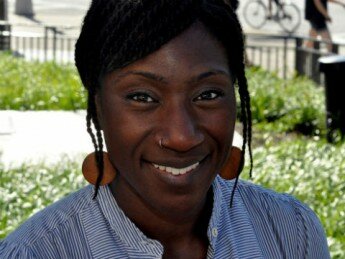
Trish Tchume
In this special series, we’ll take a brief look at various different fearless inspirations from the past week or so. Whether it’s a fearless young changemaker who is taking risks, a new publication that expresses bold and innovative ideas, or an organization that is promoting change and that is not afraid to fail forward—we want to shine a spotlight on them and their work in the hope that it will spark a new movement to Be Fearless.
As Jean Case, CEO of the Case Foundation says, “The old way of doing things is simply no longer effective in this new world. It’s time for us all to take risks on new ideas, approaches, and initiatives. It’s time for us to be bold, to act with urgency, and to resist the tendency to let caution be our guide. It’s time for us to Be Fearless.” Will you join us?
Be Fearless Q&A with Trish Tchume
Trish Tchume is proud to serve as the first ever National Director of the Young Nonprofit Professionals Network (YNPN) after almost eight years of volunteering for the organization. Through its national network of 34 chapters and 30,000 members, YNPN advocates for a sector that is more sustainable and effective in its talent recruitment, retention, and development practices. YNPN is building a network of leaders around the country who can design, advocate for, and lead this more sustainable and effective nonprofit sector.
1. What do you think it means to Be Fearless in approaching social challenges?
When it comes to approaching social challenges, I think the most fearless thing that a leader can do is cede control. There’s a perception that in order to solve problems, we have to be at the center of the solution – coming up with ideas, choosing the implementers, figuring out the timing.
There’s a sense that as long as we’re moving all of the pieces, it’s more likely that we’ll have the impact that we want to see or at least we won’t have to deal with the fear of not knowing every step of the process.
We’re living in an age, however, where everything from open source technology online (Mozilla, the App Store) to offline social movements (#OWS) are showing us plainly that the most revolutionary change happens when leadership is shared among many.
2. Tell us about a time when you and your organization were Fearless.
As I prepared to step into my role as director of a membership association six months ago, I checked in with others in the field who hold similar positions. Several strongly advised against allowing members to play a central role in making decisions for the organization. They warned that inclusive decision-making processes, while good for PR, often proved to be highly inefficient and members could rarely be trusted to make decisions, which required them to prioritize the good of the whole.
The board and I took this advice under serious consideration as we discussed how to begin the network-wide infrastructure-building process that YNPN recently launched (which we refer to as YNPN 3.0.) We knew that creating an inclusive process might mean having to be more deliberative and that chapter priorities might not always align with National’s.
We decided, however, that an inclusive decision-making structure was a better reflection of our historical roots, a better reflection of the network and the sector we wanted to be a part of in the future, and it created space for more leadership and more creative ideas to emerge.
So two months ago we took a leap of faith, ceded some control, and put a stake in the ground for inclusive decision-making by launching our first ever YNPN Chapter Congress.
3. What did you learn & what advice would you give other organizations that are facing a similar decision point?
We’ve learned quickly that shared decision-making doesn’t mean that there is no longer a role for a strong leader who is ultimately accountable for the upholding the mission of the organization. Our chapters don’t want to be involved in every organizational decision, nor should they be. But we can create and actually make good use of clear spaces for member input and decision-making.
We view our Chapter Congress as more than a space for building goodwill amongst our member institutions -- we see it as a critical part of our growth and sustainability as a network. The level of engagement we’ve seen from chapters in just the first two months signals to us that this was absolutely the right approach and has actually increased our capacity for developing and implementing innovative ideas for strengthening the network.
4. What inspired your organization to be Fearless (can be a person, organization, campaign, etc.?)
I often point to Zephyr Teachout, Director of Internet Organizing for the 2004 Howard Dean campaign as someone who helped strengthen my commitment to inclusive leadership. At this point it may be hard for us to remember the early days of internet organizing, but Zephyr and the Dean campaign were on the cutting edge – not just in terms of technology but in terms of philosophy. I heard her speak in 2005 and she talked about the point when she and Joe Trippi realized that there was a base organizing for Dean that had no connection to the “official campaign.”
Instead of trying to rein it in or distinguish these excited constituents from the “official campaign,” they focused instead on connecting them via tools like Meetup.com, providing them with a common framework for understanding the candidate’s platform, then trusting that their constituents were smart, creative, and would do the right thing even if it didn’t look exactly like what was in the campaign organizers’ playbook. The Dean campaign forever changed the way tens of thousands of Americans thought about their role in electoral politics. If YNPN can serve as a space for just as many young people to be awakened to the societal impact they can have via the nonprofit sector, I would be very proud.