


Photo courtesy of CIRCLE
In this special series, we’ll take a brief look at various different fearless inspirations from the past week or so. Whether it’s a fearless young changemaker who is taking risks, a new publication that expresses bold and innovative ideas, or an organization that is promoting change and that is not afraid to fail forward—we want to shine a spotlight on them and their work in the hope that it will spark a new movement to Be Fearless.
As Jean Case, CEO of the Case Foundation says, “The old way of doing things is simply no longer effective in this new world. It’s time for us all to take risks on new ideas, approaches, and initiatives. It’s time for us to be bold, to act with urgency, and to resist the tendency to let caution be our guide. It’s time for us to Be Fearless.” Will you join us?
The Power of the Youth Vote
This week, youth in America made history once again by turning out in strong numbers to vote in the presidential elections and voicing their concerns via ballot. Voters ages 18 to 29 played an integral role in the election - and in particular the battle ground "swing" stages. As Peter Levine of CIRCLE notes, "youth turnout of around 50 percent is the ‘new normal’ for presidential elections."
*Content provided by CIRCLE
The Center for Information and Research on Civic Learning and Engagement (CIRCLE) released an exclusive turnout estimate showing that 22-23 million young Americans (ages 18-29), or at least 49 percent, voted in Tuesday’s presidential election, according to national exit polls, demographic data, and current counts of votes cast.
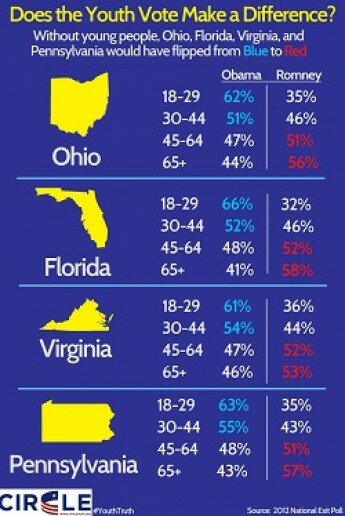
In Florida, Ohio, Pennsylvania and Virginia, if Romney had won half the youth vote, or if young people had stayed home all together, he would have won those key battleground states.
A switch of those 80 electoral votes would have also changed the presidency, electing Romney as president. (More on that analysis here.) Young people represented 19% of the voters in yesterday’s election, with President Obama winning the majority of those votes over Governor Romney by 60 percent to 37 percent, according to the early released National Exit Polls (NEP).
“Confounding almost all predictions, the youth vote held up in 2012 and yet again was the deciding factor in determining which candidate was elected President of the United States,” said CIRCLE director Peter Levine. “Young people are energized and committed voters. Youth turnout of around 50 percent is the ‘new normal’ for presidential elections. Considering that there are 46 million people between 18 and 29, this level of turnout makes them an essential political bloc. Right now, they form a key part of the Democrats’ national coalition. Republicans must find a way to compete for their votes.”
According to CIRCLE’s exclusive estimate, youth voter turnout was at least 49.3 percent, based on data from about 97 percent of precincts that have fully reported their votes as of Wednesday morning. Youth turnout may reach 51 percent when the remaining 3 percent of precincts report. The minimum CIRCLE estimated at the same point in time in 2008 was 48.3 percent, but our 2008 estimate rose to 52 percent as more precincts reported. That means that 2004, 2008, and 2012 have been three strong elections in a row for youth, with turnout in the vicinity of 50 percent each time, compared to just 37 percent in 1996 and 41 percent in 2000.
These estimates are subject to change, because in several states, less than 95 percent of precincts are reporting. Also, in some past years, the NEP, conducted by Edison Research, have adjusted their statistics in the first few days after an election. CIRCLE estimates youth voting after elections based on several variables, including the total number of ballots counted and the exit polls. These variables are subject to change in the hours and days after an election.